Tell Us the Decision You Need to Make. We’ll Help Build the Case.
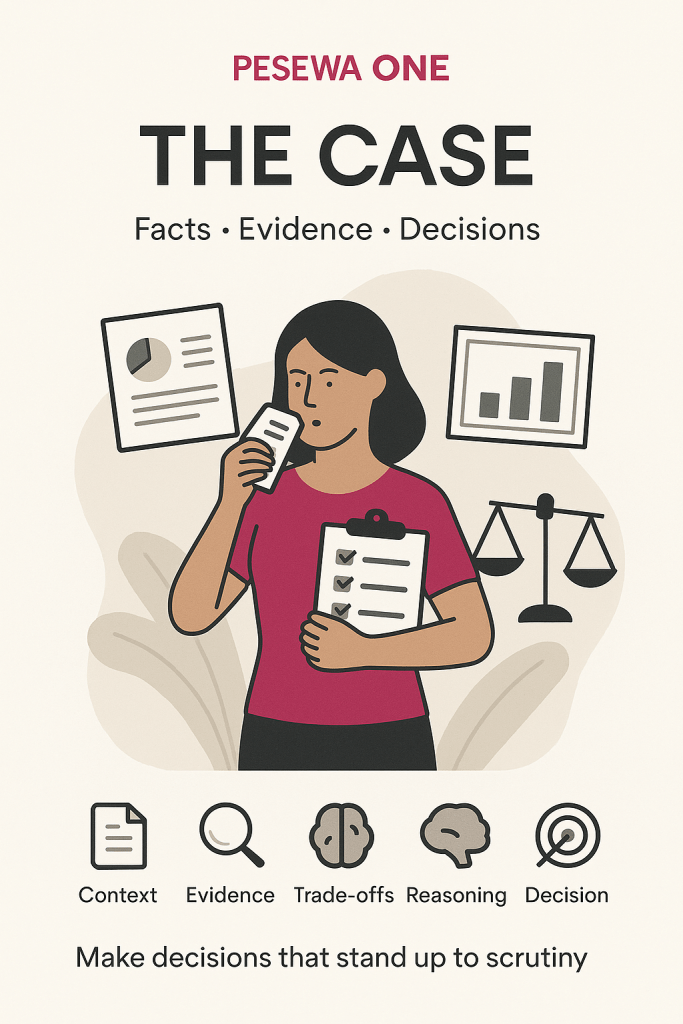
The Case helps individuals, businesses, teams, and leaders make important decisions with better evidence, clearer reasoning, and a stronger understanding of the trade-offs involved.
Should we enter this market?
Should we hire this person?
Should we acquire this business?
Should we launch this product?
Should we accept this proposal?
Should we invest in this project?
Should we change strategy?
Should we proceed at all?
Tell Pesewa ONE the decision you are facing.
The Case helps define the real question, gather the relevant evidence, identify what is still unknown, compare the available options, test assumptions, consider risks, and build a reasoned recommendation.
You do not need to become an expert in decision theory.
Bring us the decision. Pesewa ONE helps build the case around it.
What The Case Can Do for You
Define the Real Decision
Important decisions are often framed badly from the beginning.
Someone may ask:
“Should we launch this product?”
But the more useful question may be:
“Which customer problem should we solve, and is this product the best way to solve it?”
Someone may ask:
“Should we hire this candidate?”
The real question may be:
“What capability does the organization actually need, and which option best provides it?”
The Case helps clarify:
– What decision is actually being made
– Why the decision matters
– Who is affected
– What constraints exist
– What success would look like
– When a decision needs to be made
A better decision starts with a better question.
Separate the Facts From the Assumptions
Many decisions appear evidence-based when they actually rest on assumptions.
The Case can help distinguish between:
What We Know
Information supported by evidence.
What We Believe
Reasonable interpretations that may still need testing.
What We Assume
Things being treated as true without enough evidence.
What We Do Not Know
Important gaps that could materially affect the decision.
This prevents confidence from being mistaken for evidence.
Find the Evidence That Matters
Once the question is clear, The Case can help identify and organize relevant evidence such as:
– Financial information
– Market research
– Customer evidence
– Operational data
– Expert opinion
– Industry benchmarks
– Academic research
– Legal or regulatory information
– Historical performance
– Comparable cases
– Stakeholder perspectives
The aim is not to collect everything available.
It is to find the information that could actually change the decision.
Test the Quality of the Evidence
Not all evidence deserves equal weight.
The Case can help examine questions such as:
– Where did this information come from?
– How recent is it?
– Is the source credible?
– Is the evidence complete?
– Does it directly support the conclusion?
– Are there contradictory sources?
– Could there be bias?
– Are we relying too heavily on one data point?
This helps distinguish:
“We found something that supports our argument.”
from:
“The available evidence reasonably supports this conclusion.”
Identify What Is Missing
Sometimes the correct response is not yet:
Yes.
or:
No.
It may be:
“We need to know one more thing before deciding.”
The Case can work with Gap Data Mapping to identify missing information that could materially affect the outcome.
For example:
We do not know the real customer acquisition cost.
We have not validated demand.
The financial assumptions are incomplete.
We do not know whether the required license can be obtained.
We have not tested the operational capacity required.
The next step then becomes clear:
Fill the critical gap before committing.
Develop the Real Options
Poor decisions often happen because only two choices are considered.
Do it.
or:
Do not do it.
The Case can help identify alternatives such as:
– Proceed fully
– Run a pilot
– Delay
– Modify the proposal
– Partner with another organization
– Outsource part of the work
– Acquire instead of build
– Build instead of acquire
– Enter one market before another
– Negotiate different terms
– Stop the initiative
Sometimes the strongest decision comes from discovering an option that was not originally on the table.
Compare the Options
The Case can help evaluate each option against factors such as:
– Strategic fit
– Financial impact
– Cost
– Time
– Risk
– Capability requirements
– Reversibility
– Opportunity cost
– Customer impact
– Operational complexity
– Stakeholder impact
– Long-term implications
This makes trade-offs visible.
Every serious choice gives something up.
The Case helps make those sacrifices explicit rather than allowing them to remain hidden.
Understand the Trade-Offs
A decision may increase growth but reduce cash reserves.
Another may lower risk but slow expansion.
Another may be strategically attractive but operationally difficult.
The Case helps explain these tensions clearly.
For example:
Option A offers the highest potential return but requires the most capital.
Option B produces slower growth but preserves flexibility.
Option C carries less financial risk but creates greater strategic dependence on a partner.
The goal is not to pretend there is always a perfect choice.
It is to understand what you are choosing—and what you are giving up.
Test What Has to Be True
One of the most powerful questions in decision-making is:
What has to be true for this decision to work?
For an expansion strategy:
Demand must exist.
The company must raise sufficient capital.
The team must be able to deliver.
Margins must remain viable.
Regulatory approval must be achievable.
The Case can identify these critical assumptions and test how well supported they are.
If too many important conditions depend on hope rather than evidence, the decision may need to change.
Ask What Could Make Us Wrong
Good reasoning should challenge its own conclusion.
The Case can help deliberately ask:
– What evidence contradicts our view?
– What are we overlooking?
– What would someone who disagrees say?
– Are we becoming attached to one option?
– Are we interpreting evidence selectively?
– What could make this decision fail?
– What would have to happen for us to reverse our recommendation?
This makes the recommendation stronger.
A conclusion should survive challenge before it is asked to survive reality.
Consider Different Scenarios
Some decisions depend heavily on what happens next.
The Case can help consider:
Base Case
What happens if events unfold broadly as expected?
Upside Case
What happens if key assumptions perform better than expected?
Downside Case
What happens if important assumptions fail?
Stress Case
What happens under a more severe adverse scenario?
The purpose is not to predict the future perfectly.
It is to understand how resilient the decision may be under different conditions.
Consider the Cost of Doing Nothing
One option is often overlooked:
Maintain the status quo.
But doing nothing also has consequences.
The Case can help compare:
What happens if we act?
with:
What happens if we do nothing?
A decision to delay may preserve capital.
It may also allow a competitor to establish the market first.
A decision not to hire may reduce costs.
It may also leave an important capability gap unresolved.
Inaction is still a decision.
Turn the Analysis Into a Recommendation
At some point, analysis needs to lead somewhere.
The Case can help bring the work together into a clear recommendation:
Decision
What should be done?
Rationale
Why?
Evidence
What supports the recommendation?
Trade-Offs
What are we accepting by choosing this option?
Risks
What could go wrong?
Conditions
What needs to be true?
Next Steps
What should happen now?
The objective is not simply:
“Here is the analysis.”
It is:
“Based on the available evidence, this is the recommended course of action and why.”
Create a Decision Record
Important decisions are often revisited months or years later.
People ask:
Why did we decide this?
What information did we have at the time?
Which assumptions were made?
What alternatives were considered?
The Case can help create a record showing:
– The decision
– Context
– Evidence considered
– Options reviewed
– Key assumptions
– Risks
– Recommendation
– Who decided
– Follow-up actions
This builds institutional memory.
It also makes future learning possible.
Review the Decision Later
A decision should sometimes be evaluated after the outcome is known.
The Case can help ask:
What did we expect?
What actually happened?
Which assumptions were right?
Which assumptions were wrong?
Was the decision itself poor, or did the outcome simply turn out badly?
What should we learn for next time?
This distinction matters.
A good decision can still produce a bad outcome.
A bad decision can occasionally get lucky.
The purpose is to improve the quality of future decisions, not simply judge results with hindsight.
For Businesses
A business may ask:
“Should we open another location?”
The Case can help assess:
– Current business performance
– Customer demand
– Location economics
– Capital requirements
– Operational capacity
– Competitive conditions
– Risks
– Alternative expansion options
The output is not another dashboard.
It is a reasoned expansion recommendation.
For Entrepreneurs
An entrepreneur may ask:
“Should I leave my job and pursue this business full-time?”
The Case can help organize the relevant considerations around:
– Evidence of demand
– Financial runway
– Opportunity cost
– Personal constraints
– Business progress
– Alternative approaches
– Key uncertainties
The final choice remains personal.
Pesewa ONE helps make the reasoning more structured.
For Investment and Acquisition Decisions
A company may ask:
“Should we acquire this business?”
The Case can bring together:
– Strategic rationale
– Financial analysis
– Valuation
– Due diligence findings
– Operational fit
– People considerations
– Integration risks
– Alternative uses of capital
This can work directly with the Small Businesses M&A Market and relevant professionals.
For Leadership Teams
Leadership teams regularly face choices involving:
– Strategy
– Investment
– Hiring
– Restructuring
– Partnerships
– New markets
– Products
– Technology
– Risk
– Resource allocation
The Case can help turn competing arguments into a structured decision process.
Strong leadership is not simply making decisions quickly. It is knowing when a decision has been examined enough to act.
For Personal Decisions
The Case can also help individuals structure important non-clinical, non-regulated decisions around:
– Career choices
– Education
– Business opportunities
– Major purchases
– Relocation
– Projects
– Competing priorities
The user defines what matters.
Pesewa ONE helps organize the decision around those priorities.
Connected to Pesewa ONE
The Case can become one of the key reasoning layers across the Pesewa ONE ecosystem.
Gap Data Mapping can identify what information is missing.
Pesewa Knowledge can research the evidence.
Your Bookkeeper can provide financial information.
Real-Time Market can provide current commercial signals.
Stock Markets Today can provide relevant financial-market context.
Pesewa Experts can contribute specialist knowledge.
Pesewa Opportunities can identify alternative opportunities.
Perfect Pitch can turn the final recommendation into a compelling presentation.
The Board can use The Case to support major governance and strategic decisions.
The Manager can convert the decision into action.
Pesewa Workflow can coordinate implementation.
Pesewa AI can support research, comparison, synthesis, scenario development, and documentation behind the scenes.
The user does not need to assemble these tools themselves.
Bring Pesewa ONE the decision. The Case helps assemble the reasoning around it.
The Case and The Board
These two capabilities should have distinct roles.
The Case
Answers:
“What should we do, and why?”
It structures the evidence, alternatives, assumptions, trade-offs, and recommendation around a specific decision.
The Board
Answers:
“What does the organization need to decide, who is accountable, and what happens afterward?”
The Board provides the wider governance and decision environment.
Together:
The Case builds the argument.
The Board makes and governs the decision.
The Case and Gap Data Mapping
These should also work closely together.
Gap Data Mapping
Asks:
“What do we still need to know before deciding?”
The Case
Asks:
“Given what we know, what should we conclude?”
A natural sequence becomes:
Decision → Frame the Question → Identify Evidence → Find the Gaps → Fill Critical Gaps → Compare Options → Build the Case → Decide → Act
Why The Case Matters
Important decisions are often made under pressure.
There is limited time.
Different people have different views.
Evidence is incomplete.
Strong personalities influence the room.
Teams become attached to an idea.
Assumptions gradually become accepted as facts.
Then the decision is made.
The Case introduces discipline before commitment.
Instead of:
“Use our decision-analysis platform.”
Pesewa ONE says:
“Tell us the decision you need to make. We’ll help examine the evidence, challenge the assumptions, compare the options, and build a defensible recommendation.”
A Good Decision Should Be Able to Explain Itself.
The Case is not another analytics tool.
It is a decision-support service designed to move people from:
Question → Evidence
Evidence → Options
Options → Trade-Offs
Trade-Offs → Recommendation
Recommendation → Decision
Decision → Learning
The Case
Know the Facts. Test the Options. Make the Decision.
 Pesewa AI