Understand What Is Happening Between People. Improve How They Work Together.
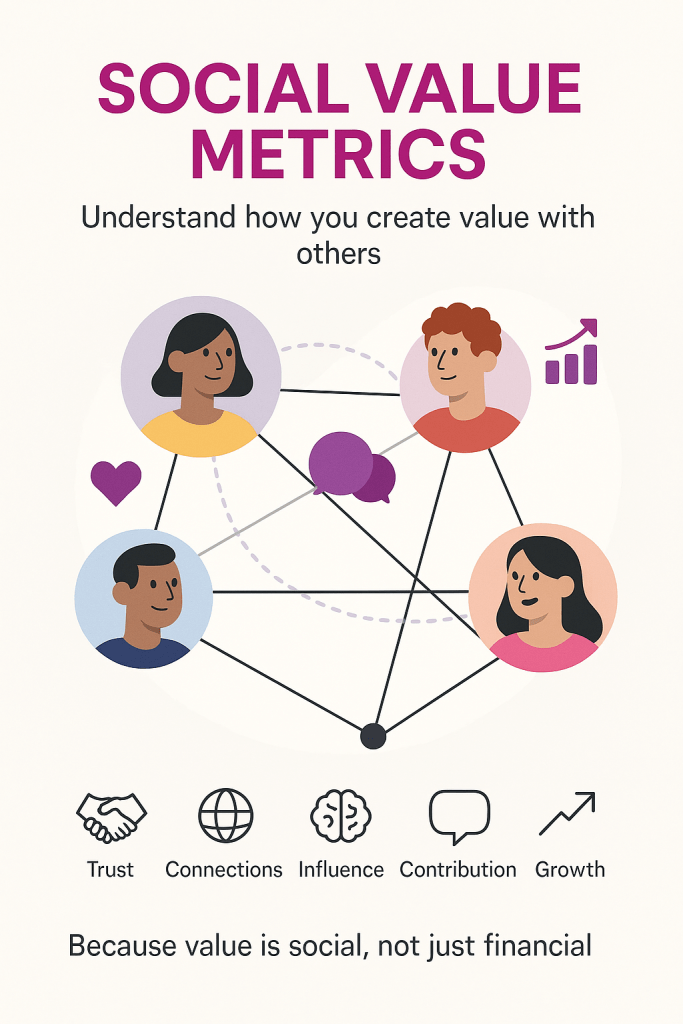
Social Value Metrics helps businesses, institutions, teams, and communities understand the human relationships that may be helping or preventing them from achieving their goals.
A team is talented but still underperforming.
Departments do not collaborate.
Employees no longer trust management.
A partnership keeps breaking down.
People are not sharing information.
A new team cannot seem to work together.
A community project has participation but little cooperation.
Tell Pesewa ONE what is happening.
Social Value Metrics helps examine the underlying patterns of trust, cooperation, communication, contribution, relationships, and working dynamics that may be influencing the outcome.
Behind the scenes, Pesewa ONE can combine structured feedback, organizational information, observation, research, appropriate assessments, and AI-supported analysis to help understand what may need attention.
You do not need to become an expert in social-capital theory.
Tell us where people are struggling to work together. SVM helps identify what may be getting in the way.
What Social Value Metrics Can Do
Understand Why a Team Is Not Working
Sometimes a team looks strong on paper.
Everyone is qualified.
Roles have been assigned.
Resources are available.
Yet performance remains weak.
SVM can help examine questions such as:
– Do people trust one another?
– Is information being shared?
– Are responsibilities clear?
– Are people cooperating?
– Is leadership creating confidence?
– Are some voices being ignored?
– Are commitments being followed through?
– Is there a breakdown between groups?
The objective is not simply to produce another employee survey.
It is to understand what is happening between people that may be affecting the work.
Identify Where Trust Is Breaking Down
Trust affects how quickly people cooperate, share information, ask for help, and take responsibility.
SVM can help organizations investigate situations where:
– Employees do not trust leadership
– Teams do not trust one another
– Partners are becoming defensive
– Communication is becoming guarded
– People avoid taking responsibility
– Collaboration repeatedly fails
The next question is then:
What could be changed to rebuild confidence and improve the relationship?
Help Build Better Teams
When forming or restructuring a team, organizations can use SVM alongside Pesewa Value to think more deliberately about:
– Working styles
– Communication
– Collaboration needs
– Leadership structure
– Complementary strengths
– Team relationships
– Role clarity
– Potential friction points
The goal should not be to classify people as inherently “good” or “bad” team members.
It is to ask:
What environment and combination of people may give this team the best chance of working well together?
Understand How Work Really Gets Done
Organizational charts show formal relationships.
Real work often follows informal ones.
Who do people actually ask for help?
Who connects different teams?
Where does information stop moving?
Which relationships keep projects moving?
Where are important groups disconnected?
SVM can help organizations understand these patterns more clearly.
This can reveal valuable contributors whose importance may not be obvious from job titles alone.
Sometimes the people holding an organization together are not the people highest on the organizational chart.
Understand Collaboration Across Teams
Organizations frequently struggle with silos.
Sales blames operations.
Operations blames technology.
Head office misunderstands local teams.
Departments protect information.
SVM can help examine:
– Communication between groups
– Cooperation across functions
– Information flow
– Repeated conflict
– Trust between teams
– Shared objectives
– Dependencies
This helps identify where collaboration needs to improve if the wider organization is going to succeed.
Understand Leadership Impact
Leadership is not simply a job title.
Leaders influence:
– Trust
– Communication
– Motivation
– Participation
– Psychological safety
– Cooperation
– Follow-through
SVM can help organizations examine how leadership practices may be affecting the people around them.
The purpose is developmental.
What is helping this team perform?
What leadership behavior may be making the work harder?
What could be done differently?
Make Contribution More Visible
Some people create value that conventional performance measures do not easily capture.
They:
Help colleagues solve problems.
Connect teams.
Share knowledge.
Mentor others.
Create trust.
Bring people together.
Help difficult projects move forward.
SVM can help organizations recognize these forms of contribution alongside more traditional measures of output.
This creates a richer picture of how value is actually created inside an organization.
Understand Whether a Community Can Work Together
SVM can also support community and collaborative initiatives.
A project may have funding and participants but still struggle because:
People do not trust the organizers.
Groups do not cooperate.
Participation is concentrated among a few individuals.
Information does not reach everyone.
Existing tensions undermine collaboration.
SVM can help identify these dynamics so Pesewa ONE can design better approaches to participation and coordination.
Track Whether Relationships Are Improving
Organizational interventions should eventually produce change.
SVM can help examine whether factors such as:
– Trust
– Communication
– Cooperation
– Participation
– Cross-team relationships
– Contribution
appear to be improving, weakening, or remaining unchanged over time.
The objective is not constant surveillance.
It is to help answer:
“Did the intervention actually improve how people work together?”
From Insight to Intervention
SVM becomes valuable when the insight leads to practical action.
For example:
SVM Finds:
Two departments rarely exchange information until problems become urgent.
Pesewa ONE Can Help:
Redesign the workflow, clarify responsibilities, and establish regular coordination.
SVM Finds:
Employees understand the strategy but do not trust leadership to follow through.
Pesewa ONE Can Help:
The Board and The Manager can address decision transparency, commitments, and follow-up.
SVM Finds:
One individual has become an important bridge between several teams.
Pesewa ONE Can Help:
Recognize that contribution and reduce the organizational dependence on one informal connector.
SVM Finds:
A new team has strong technical capability but weak collaboration.
Pesewa ONE Can Help:
Pesewa Value can support team development, role clarity, and leadership interventions.
SVM Finds:
A community initiative has many registered participants but very little actual contribution.
Pesewa ONE Can Help:
Your Community can redesign participation around specific needs and practical opportunities to contribute.
Use SVM to Improve Systems, Not Label People
Social Value Metrics should be used carefully.
Trust, influence, contribution, and cooperation are contextual.
A person’s behavior in one team or environment may look very different in another.
SVM should therefore avoid simplistic labels such as:
“Trustworthy person.”
“Low-value employee.”
“Poor citizen.”
“High-influence individual.”
Instead, the emphasis should be on questions such as:
What is happening in this environment?
What behaviors are helping or hurting collaboration?
What conditions may be influencing those behaviors?
What could improve the system?
Where individual-level information is used, people should understand the purpose, the information being considered, and how it may affect them.
SVM Should Support Decisions, Not Make Them Alone
SVM can provide useful evidence.
It should not automatically determine:
– Who gets hired
– Who gets fired
– Who gets promoted
– Who receives credit
– Who receives essential services
– Who is considered trustworthy
– Who is considered a good citizen
Important decisions about people should include appropriate human judgment, context, relevant evidence, and safeguards.
SVM helps people ask better questions. It should not become the unquestioned answer.
Connected to Pesewa Value
SVM can become one of the important analytical capabilities behind Pesewa Value.
For example:
Pesewa Value may be asked:
“Why is this team underperforming?”
SVM can help examine the relationship dynamics.
Pesewa Value can then help turn those insights into:
– Team interventions
– Leadership development
– Role changes
– Coaching
– Communication improvements
– Organizational redesign
The customer does not need to purchase “social-capital analytics.”
They need the team to work better.
SVM provides part of the intelligence Pesewa ONE uses to help make that happen.
Connected to Pesewa ONE
SVM can support several other Pesewa ONE services.
Pesewa Value can use SVM to understand teams and workplace dynamics.
The Board can use relevant findings to understand governance and leadership issues.
The Manager can address coordination and accountability problems.
Pesewa Workflow can redesign processes where poor coordination contributes to weak relationships.
Business-as-ONE Projects can use appropriate insights to improve collaboration across independent businesses.
Your Community can use SVM to understand participation and community relationships.
GSIP can use structured feedback to improve teamwork and professional development.
Pesewa CoINS can recognize documented contribution without turning SVM into a social ranking system.
Gap Data Mapping can identify where insufficient information makes conclusions about people unreliable.
Pesewa AI can support appropriate analysis and synthesis behind the scenes.
The user does not need to manage these analytical systems separately.
SVM helps Pesewa ONE understand the human dynamics. The rest of the ecosystem helps act on them.
Why Social Value Metrics Matters
Organizations can measure:
Revenue.
Costs.
Sales.
Tasks.
Hours.
Projects.
Output.
Yet some of the most important drivers of performance remain difficult to see.
Trust.
Cooperation.
Communication.
Relationships.
Reciprocity.
Contribution.
A technically excellent organization can still fail when these systems break down.
SVM helps make those dynamics easier to understand.
Instead of:
“We measure your employees’ trust and social value.”
Pesewa ONE says:
“Tell us where people are struggling to work together. We’ll help understand what is happening between them and what could improve it.”
Performance Is Not Only About What People Do. It Is Also About How People Work Together.
Social Value Metrics is not a system for ranking human beings.
It is a framework for helping organizations understand the relationships and behaviors that influence collective performance.
Understand the relationships.
Find the friction.
Strengthen the system.
Improve the outcome.
Social Value Metrics
Make the Human Side of Performance Visible.
 Pesewa AI